Minister of Science and Culture Mari-Leena Talvitie has presented seven State Awards for Public Information in acknowledgment of work that has improved the availability of information for citizens and stimulated broader public discussion.
The 2026 award winners make the world more understandable in a way that combines research, experience and observations. Two of the awards are community awards and one is awarded posthumously. The award ceremony was celebrated on 8 June in Oulu, which is a European Capital of Culture this year.
“Publication of information is a cornerstone of democracy. It helps to make an increasingly complex world more understandable, strengthens trust and creates the conditions for constructive public debate. Carefully produced information enables us to better structure our understanding, make informed decisions and, in doing so, build a more sustainable future,” says Minister of Science and Culture Mari-Leena Talvitie.
The best work does more than simply share information: it changes what can be discussed in society:
– It gives voice to experiences that have lacked a common language, and it brings to light complex topics and everyday yet unnoticed information, said Liisa Suvikumpu, Chair of the Committee for Public Information (TJNK), in her speech.
The State Award for Public Information is the highest national recognition for distinguished publication of information. The Ministry of Education and Culture confers the State Awards annually on the proposal of TJNK. They are part of the honours system of Finland, which dates back to the 1880s. The State Award for Public Information has been in place since 1968.
The 2026 Finnish State Awards for Public Information
Commissioners of the Sámi Truth and Reconciliation Commission in Finland Hannele Pokka, Professor of Practice and Doctor of Law; Irja Jefremoff, Master of Administrative Sciences; Kari Mäkinen, Archbishop Emeritus and Doctor of Theology; Anni-Siiri Länsman, University Lecturer Emerita and Doctor of Social Sciences; and Heikki Paltto, reindeer herder and entrepreneur, for bringing difficult historical experiences to light in order to increase social understanding and promote dialogue
The work of the Sámi Truth and Reconciliation Commission in Finland is public information at its most valuable. It has required deep expertise, careful consideration and personal commitment from those involved. The information that the Commission has made public is reflected in both decision-making and public discourse and culture.
The Finnish state was built on the lands of the Finns and the Sámi, but the experiences of the Sámi have long remained private. The ability to confront the painful chapters of one's history is essential for a functioning and just society. To achieve this, difficult and painful experiences must be brought to light and addressed. This is the only way to lay the groundwork for further progress and a more cohesive society.
The work of the Truth and Reconciliation Commission uses information to strengthen the foundations for building the future of the Sámi people and their culture in Finland. Despite the difficult starting point, the commissioners succeeded in building trust, which led to historically significant, unifying and far-reaching outcomes through the hearings.
The prize money of EUR 30,000 is shared evenly among the recipients.
Producers Annika Löfgren and Christina Staffans, Host Joakim Lax and Experts Anders Albrecht, Jörgen Palmgren, Hans Hästbacka, Mimma Ekblad, Torgny Backman, Niclas Fritzén and Johan Ekroos, as well as Producer Olli Koski, Host Minna Pyykkö and Experts Heidi Kinnunen, Jaakko Kullberg, Juha Laaksonen, Ari Saura and Henry Väre for producing the long-running Naturväktarna and Luontoilta programmes, as well as for strengthening the involvement of the general public and increasing interest in nature
Since 1971, the Swedish-language programme Naturväktarna has been faithfully taking and answering listeners' questions live, combining listeners' observations with contemplative discussion rooted in strong expertise and knowledge. The Finnish-language Luontoilta programme has also been reflecting, in its laid-back style, on nature observations and questions on topics ranging from parsnips to sneezewort for over 50 years.
These two programmes that span multiple generations have answered questions from both children and adults about all things wildlife and nature: from insects to large predators, urban environments to deserts, shining a spotlight on what happens on the deepest seabed and in the dark of night while we sleep.
Our surroundings are constantly changing, with humanity's relationship with nature at risk of being eroded and weakened by urbanisation, so these programmes play an ever-important role in igniting curiosity and educating and entertaining audiences about all the exciting things that live around us.
Over the decades, the experts have changed, but the underlying concept of combining the observations of ordinary people with expert knowledge remains strong. The radio programmes Naturväktarna and Luontoilta are also pioneers in multi-channel science communication, as their model has been used to answer the public’s questions on television, in newspapers, in books and online.
The prize money of EUR 50,000 is shared evenly among the recipients.
Timo R. Stewart, Doctor of Social Sciences, researcher and non-fiction writer, for his book Palestiina ja Israel. Historia karttoina (Palestine and Israel. A History in Maps), which sheds light on the historical background of the current conflict
Timo R. Stewart has made this exceptionally complex subject accessible to a Finnish audience without losing sight of its historical and political complexity. His book Palestiina ja Israel. Historia karttoina shows how maps do not merely depict reality but also construct it.
The maps reveal how the region’s history and borders, as well as issues of power and rights, have been interpreted, justified and contested at different times. Stewart provides readers with the tools to distinguish
between information, interpretation and propaganda, and to view the present within a broader historical context. At the same time, he highlights how visual representations shape our perceptions of conflicts and the parties involved.
Stewart’s key merit is his research-based approach to presenting a controversial and emotionally charged topic to the general public. His clear and illustrative presentation style makes this difficult topic approachable without oversimplifying it. Palestiina ja Israel. Historia karttoina is an excellent example of public information that deepens the public discourse through research and strengthens our understanding of one of the most significant political conflicts of our time.
[Palestiina ja Israel. Historia karttoina, Gummerus 2025]
A prize of EUR 15,000 in total.
Leea Lakka, Doctor of Philosophy, for her important book Kapina pulpetissa. Mitä vuosi takarivissä opetti lukemisesta, kirjoittamisesta ja taitojen eriytymisestä (Rebellion at the Desk. What a Year in the Back Row Taught Me About Reading, Writing and the Segregation of Skills)
Leea Lakka spent a year among ninth-graders at comprehensive school and noticed that pupils in the back row kept not only physical but also emotional distance from the teacher and schoolwork. They have a flippant attitude towards studying, consider the subject matter pointless and avoid making any effort by employing numerous tactics. As evidenced by the PISA survey, some pupils struggle with reading to such an extent that they are unable to function in society.
Even though back-row pupils challenge their teachers in many ways, Lakka reminds us that we must not give up on them. A school that provides compulsory education cannot be built solely on the basis of ideal pupils. Instead, the school has an important role to play, which is to strive to reduce social segregation.
Kapina pulpetissa is based on Leea Lakka's doctoral dissertation, published a year earlier. It is an excellent example of making scientific knowledge accessible to the general public and engaging in public discourse.
[Kapina pulpetissa. Mitä vuosi takarivissä opetti lukemisesta, kirjoittamisesta ja taitojen eriytymisestä, Nemo 2025]
A prize of EUR 15,000 in total.
Sonja Koski, Docent of Biological Anthropology and researcher, for her book Simpanssi sisällämme (The Chimpanzee Within Us)
Sonja Koski's (1973–2025) Simpanssi sisällämme is a non-fiction book about chimpanzees and their closest relatives: bonobos and humans. Koski, who spent her entire career studying primates, examines the deep history of evolution in her final book and asks what kind of behaviour makes a chimpanzee a chimpanzee and a human a human.
This book offers a unique and reflective insight into the lives of chimpanzees: their intelligence and emotions, tools and cultures, sociability and belligerence, friendship and empathy, and norms and morals. To human readers, these themes are so familiar that we consider them hallmarks of our own species. Simpanssi sisällämme demonstrates that many of the behavioural traits of humans are also common to our distant relatives and have very ancient evolutionary origins. Human behaviour may well have a simian core, and we may not be as special as we often like to think.
Sonja Koski's book is not merely a concise overview of primate behaviour. The research-based knowledge is naturally interwoven throughout the book with the author’s personal account of her journey to becoming a primatologist. The story is driven by a deep respect for the subjects of the research, compassion and a longing for connection across species. In the words of the author, these are needed “so that we can embrace a worldview in which other species are equal to us and just as special and important as we are.”
[Simpanssi sisällämme, SKS Kirjat 2025.]
The award is granted posthumously without the associated prize money. The award is a tribute to Sonja Koski’s life’s work as a researcher and her outstanding book.
Finnish Wikipedians for their long-term and communal work in building and maintaining open knowledge
Wikipedia, now 25 years old, is an online encyclopaedia open to everyone. A Wikipedian, on the other hand, is someone who writes and edits articles on Wikipedia, often under a pseudonym, as part of a neutral and communal project. All kinds of people are welcome to take part, from young to old, from amateurs to top scientists, from right-wingers to left-wingers and from atheists to believers.
Tens of thousands of Finnish Wikipedians have contributed especially to the Finnish- and Swedish-language Wikipedias, as well as those in Northern Sámi and Inari Sámi. The English-language Wikipedia and other language versions would also be different without Finnish contributors. Finnish Wikipedians are shaping how the rest of the world sees Finland by writing about topics that are familiar and important to Finns.
The State Award for Public Information dedicated to all Finnish Wikipedians is presented to Wikimedia Suomi ry, an organisation that promotes the use of Wikipedia and other services maintained by the Wikimedia Foundation.
If Wikipedia were to shut down, many people looking for information would quickly find themselves in a bind.
A Community Award of EUR 20,000 is awarded to Wikimedia Finland.
The non-governmental organisation Finnwatch for its impactful and responsible production of information and for stimulating social debate
Finnwatch has resolutely and uncompromisingly investigated the activities of Finnish companies in global supply chains and brought to light any issues associated with them. The organisation has distinguished itself in particular as an investigator of corporate tax evasion, violations of workers' rights and harmful environmental impacts. Finnwatch’s work is based on thorough research, open communication and responsible dialogue: it offers companies the opportunity to review the key findings of its reports before they are published.
Finnwatch promotes public information by presenting complex economic and social phenomena in an accessible format and by expanding the knowledge base of citizens, consumers and decision-makers. The organisation’s work supports sustainable consumption, strengthens the operating conditions for companies that act responsibly and encourages the development of regulation that effectively addresses global injustices.
As an independent non-governmental organisation, Finnwatch has established itself as a key source of information and a catalyst for social debate.
A Community Award of EUR 20,000 is awarded to Finnwatch.
Inquiries: Reetta Kettunen, Secretary General, Committee for Public Information, tel. +358 40 733 5935, reetta.kettunen(at)tjnk.fi
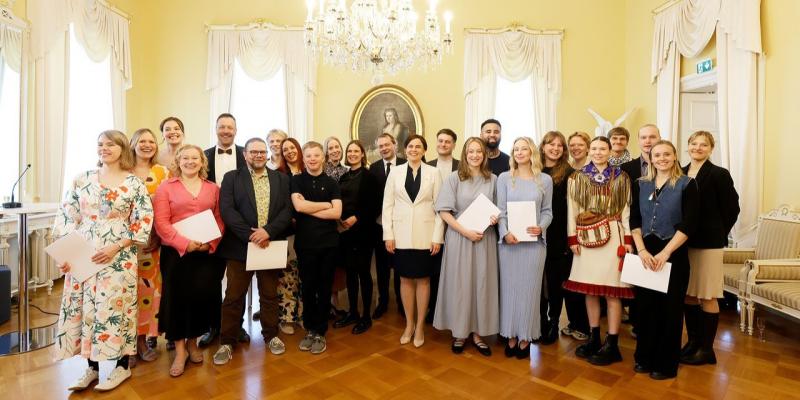
Photo: Recipients of the State Award for 2026 with Minister of Science and Culture Mari-Leena Talvitie. Mika Vallineva.
You might also be interested in